Large trades
A large trade is an execution noticeably bigger than usual for the instrument. It is commonly taken as the trace of a participant willing to trade big volume, but in the data it is only the trace of a large order, not of a large participant. This is a practice-level lesson: how to choose a threshold, why trades should be joined, what a sweep is, and what can and cannot be concluded from a large trade.
Threshold: relative, not fixed
What counts as “large” depends on the instrument. A typical Sberbank share trade is noticeably bigger than a USD/RUB futures trade, where almost all trades are a few to tens of contracts (see Time and sales). A “500 lots” threshold means a noticeable but not rare trade for the former and an exceptional one for the latter.
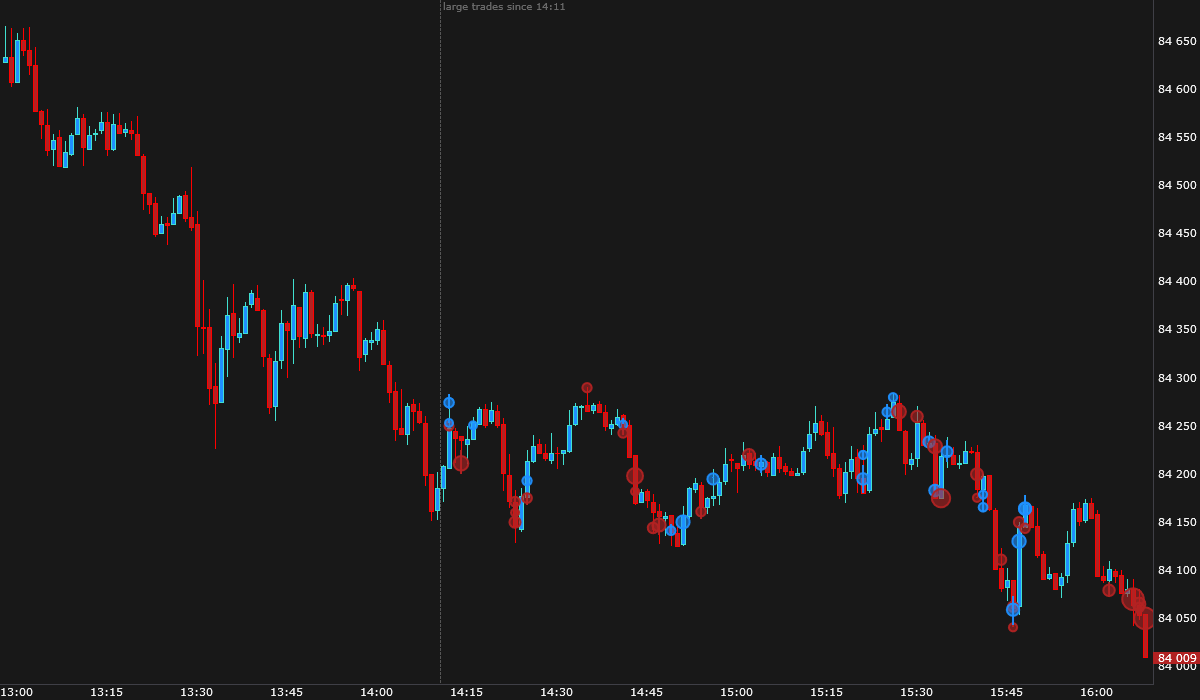
That is why the threshold is set relative to the instrument’s typical trade size. In the terminal, the automatic threshold is an order a set number of times (50 by default) larger than the average trade of recent bars. Such an order is rare, so there are few marks on the chart and each one stands out; if there are too many or too few, change the multiplier. A threshold based on the average trade adapts to the time of day: in quiet hours the average trade is smaller, and a smaller volume becomes “large”. It works the same way on crypto exchanges, where the typical trade size differs for each pair and exchange.
Joining: an order, not a trade
One aggressive order that goes through several resting orders produces a burst of trades with the same timestamp in the tape (on liquid instruments such bursts are common, not an exception). Without joining, a large order executed against twenty small resting orders will not make it into the large trades with a single one of its trades. That is why consecutive trades of the same side with the same timestamp are joined into one order; the terminal also lets you add the trades that come within a few milliseconds after the first one.
Joining has the opposite error too: two different orders of the same side that arrived in the same millisecond will be joined into one “large” order. Without order IDs they cannot be told apart.
Sweeps
A sweep is a large order that went through several price levels in one go: there was not enough volume at the best price in the order book, and the order took several levels in a row (recall the 150-lot example in the lesson How price is formed). A sweep shows urgency: the participant was willing to pay several ticks for immediate execution. The vertical line through a large-trade circle on the terminal chart is exactly the range of prices the order went through.
Large-trade delta
As with all trades, delta can be computed for large ones — large buys minus large sells per bar or since the start of the day. It answers the question of which way the largest aggressive orders went, and it can diverge from the delta of all trades: small trades may go one way and large ones the other.
A large trade is not necessarily an institution
The common interpretation “a large buy means a fund is building a position” does not follow from the data:
- a large aggressive order is more about impatience than about position size: large participants often execute positions in parts and with limit orders precisely so as not to leave large traces;
- a large order may come from a liquidity provider’s algorithm closing its position, or from an individual trader with a big account;
- joining may merge orders of different participants.
What is visible for certain: at that moment, at that price, someone was ready to execute a large volume immediately. A large trade is a reason to take a closer look at the price: at a level, on a breakout or after a long move it means different things. Watch whether price moved after it and whether an equally large opposing flow met it; read it together with the level, the market regime and your risk.
In the JetScalp terminal
Large-trade circles, sweeps, the threshold and joining — see Footprint; they work in any chart view, candlesticks included. Alert: large trade and Alert: sweep report such an order to the Notifications window even when the chart is minimized. Large orders in the order book window — Tape area; the large trade delta — the LargeTradesDelta indicator.
Summary
- The large-trade threshold is relative: dozens of times the instrument’s average trade.
- The trades of one order are joined by time; without order IDs, joining is an estimate.
- A sweep is an order that goes through several price levels, a trace of urgency.
- A large trade is the trace of a large aggressive order, not proof of an institutional investor’s actions.
Check yourself
- Why does a “500 lots” threshold work differently for
SBERandSi? - What happens to the search for large orders if trades are not joined?
- Why might a large participant leave not a single large trade in the tape?