The order book
The order book (DOM, depth of market) shows the limit orders waiting to be executed right now: at each price, how many lots participants are ready to buy or sell. This is a practice-level lesson: what you can learn from the order book and how to read it without mistakes — the order book shows participants’ current intentions, and they can change quickly.
What the order book shows
The order book is the instrument’s limit order book aggregated by price: all orders at one price add up to one level. It shows:
- the best prices — the bid and ask and the spread between them;
- depth — how many lots stand at each level near the best prices;
- changes — how levels grow, shrink, appear and disappear.
For a scalper this is the main window: the order book shows where liquidity is concentrated, where price may slow down, where to put a limit order and a stop, and how much volume a market order can take without much slippage.
The order book does not show how many separate orders stand at a level, how much volume is hidden in icebergs, or what the owners of the orders will do a second from now — so it is read together with time and sales.
Walls and vacuums
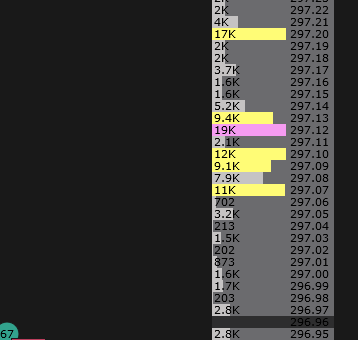
A wall is a level with noticeably more orders than its neighbors. It is often perceived as a barrier that price will have a hard time getting through. Sometimes that is true: aggressive orders really do have to fill all of that volume to get past the level. But a wall has two weaknesses.
- It can be pulled. An order in the book costs its owner nothing until it is filled. A large volume can disappear as price approaches it — and then price passes the level without any resistance.
- You may not see all of it. Part of the volume can be hidden in iceberg orders that are replenished as they fill.
A vacuum is a stretch where there are few or no orders. An aggressive order passes through a vacuum quickly: each tick of price corresponds to a small volume. That is exactly why market orders of the same size move price by different distances: everything depends on how much liquidity stands in their way (see the widget in the lesson How price is formed).
Volume imbalance
Order book imbalance is the difference between the volume on the buy side and the sell side near the best prices. If the five nearest levels hold three times as much buying as selling, it seems that price should rise. There is a connection here, but on a very short horizon — the next few seconds and the next quote change. So imbalance at the best prices is a hint for a scalper, not a forecast minutes ahead. Moreover, visible imbalance itself changes participants’ behavior: on seeing a large buy order, sellers may move their orders away, and buyers may place theirs in front of it.
More: imbalance at the best prices in research
On ten liquid Nasdaq stocks, the ratio of volumes at the best bid and ask helped predict the direction of the next change in the mid-price, more noticeably for stocks with a large tick size (Gould, Bonart, 2015 ).
Cancellations and what they mean
Most changes in the order book are not trades but orders being placed and canceled (see The continuous auction). Liquidity providers constantly move their orders after price so as not to be filled at a stale price. Therefore:
- a level that “stood there all day” may have consisted of hundreds of different orders replacing one another;
- volume quickly disappearing at the best price usually means that liquidity providers expect price to move and are getting out of the way — this is information, but not a guaranteed forecast of direction.
False conclusions from the order book
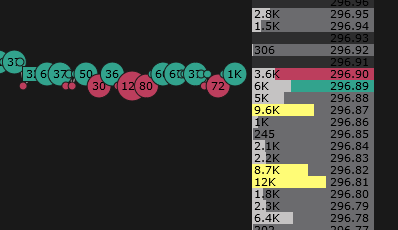
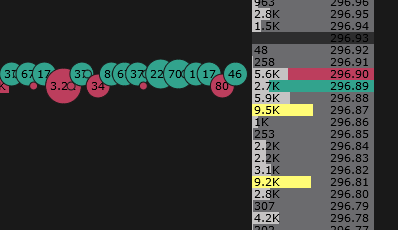
- “A large order means a large player, and they won’t let price through.” An order can be canceled at any moment. Watch how price behaves at the wall: if trades go through at it while the level stays or is replenished, it is being defended; if the volume disappeared without trades, it was pulled.
- “The wall disappeared, so it was eaten.” A level disappears in one of two ways: execution (trades at that price on the tape) or cancellation (no trades). Check against the tape.
- “There is more buying in the order book, so price will rise.” Volume in the order book is passive intentions, while price is moved by aggressive orders. Compare the book with the tape: if aggressive selling hits a large buy volume and it does not shrink, the buyer is holding the level.
Reading the order book together with the tape
The order book answers the question “how much liquidity is waiting right now”, the tape — “what actually executed”. Together they let you tell apart:
| What you see | What it means |
|---|---|
| A level shrinks, trades at that price on the tape | The level is being filled by aggressive orders. |
| A level shrinks, no trades | Orders are being canceled. |
| More traded on the tape than stood at the level, and the level did not disappear | The level was replenished: an iceberg, new orders or a liquidity provider — the data cannot tell which. |
| Price passed a level without trades at it | The orders were canceled before price got there. |
In the JetScalp terminal
The JetScalp order book highlights large volumes in color (you can set the threshold or leave it automatic), marks icebergs and can play a sound when the order you are watching for appears — Order book tab. The window layout — Order book area, placing orders from the order book — Trading from the order book.
Summary
- The order book is the current limit orders by price: where liquidity stands and how much of it is at the best prices; it does not show hidden volume or participants’ future actions.
- A wall slows price down only until it is pulled; a vacuum lets price through quickly.
- Imbalance at the best prices is a hint about the next few seconds, not a forecast minutes ahead.
- A level disappears either through execution or through cancellation; tell them apart by the tape.
Check yourself
- Why doesn’t a wall in the order book guarantee that price won’t get through it?
- How can you use the tape to tell a filled wall from a pulled one?
- What could have happened if 5,000 lots traded at a price while only 800 were visible there in the order book, and the level never disappeared?