Intraday levels
Intraday levels are prices tied to the time of the trading day: the range of the first minutes, the first hour, the previous day’s high, low and close. Their convenience is that they are the same for everyone who watches the same instrument, and so they often serve as reference points for orders and stops. This is a practice-level lesson: which levels the terminal builds, how to set the day start for the Moscow Exchange, and how volume is distributed through the day.
Important: This lesson explains how to read levels, not a signal to trade. Every entry needs a stop-loss and a position size calculated from risk (Risk and position size).
Day levels
| Level | What it is |
|---|---|
| Opening range (OR) | The high and low of the first minutes of the day, usually 5–30. |
| Initial balance (IB) | The high and low of the first hour — the reference range in Market Profile. |
| Previous day: PDH, PDL | The high and low of the previous day. |
| Previous close: PDC | The opening gap is measured from it. |
| Noise area | The usual move of the price from the day’s open for this time of day. |
How they are read: an exit from the OR is a possible start of a directional day; an IB extension is a sign of a trend; PDH and PDL are places where orders and stops often sit. A level works when there really are orders at it — so watch what happens at the level: volume, delta, the tape, the order book’s reaction. A single exit from a range is a reason to take a closer look; read it together with volume, the market regime and the risk.
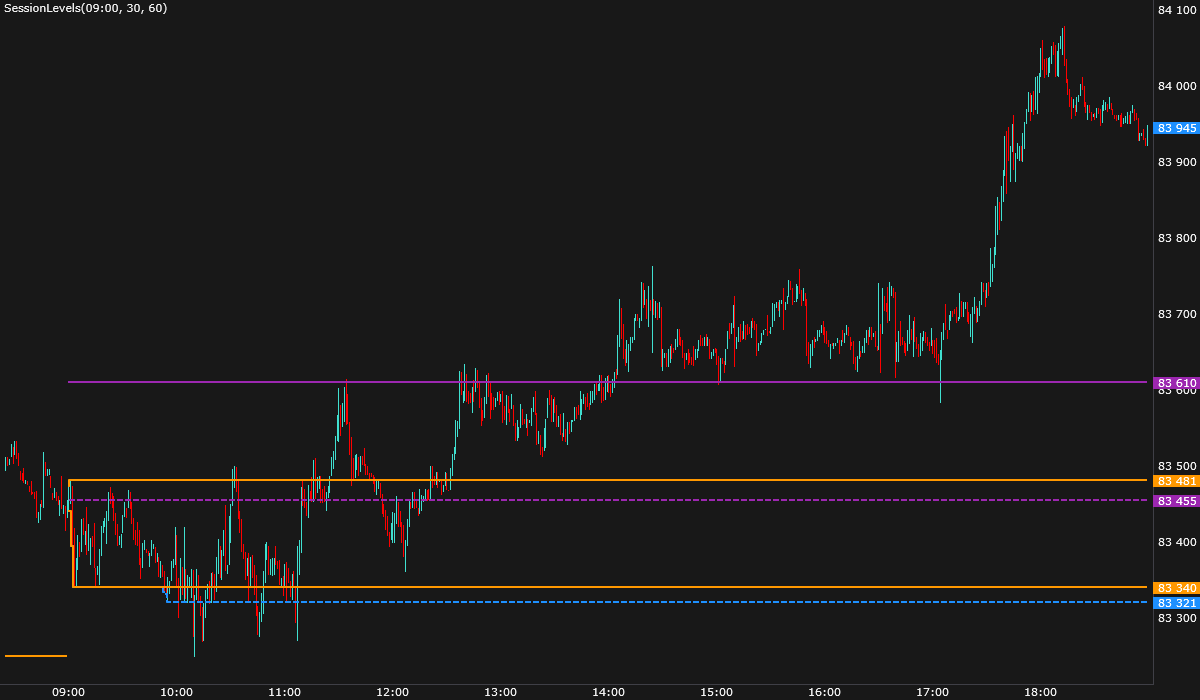
The opening range that day was 83,340–83,481. Before noon the price moved above it several times — at 11:34 even up to the previous day’s high, 83,614 with PDH at 83,610 — and by 12:15 it was back inside. From 12:33 it broke out again and never closed inside the range after that; after 14:05 it held above the previous day’s high, and in the evening it rose sharply. The first exits from the OR returned into the range, the last one held: that is why an exit is judged by the bar close, and the stop goes beyond the opposite side of the level or range.
When the day starts on MOEX
On Western exchanges the “open” is a single event. The Moscow Exchange has several, and the choice of the day’s start changes all the levels:
- around 07:00 — the morning session (preceded by an opening auction); the first trades of the day in shares come at about 06:59.
- 09:00 — the start of the main session of the equity and derivatives markets. The exchange changes its schedule from time to time — check it on the Moscow Exchange website.
- 10:00 — by volume, the main open of the day: the hour from 10:00 is the most active one (see Activity by hour).
Tip: For MOEX, set the Day start: hour parameter of SessionLevels and NoiseArea to 7 (morning session), 9 (main session) or 10 (the main open by volume). By default the day starts at midnight, and there are no MOEX trades in the first 30–60 minutes after midnight, so with the default setting the opening range and initial balance will not be drawn.
Bars before the day start belong to the previous day: with a 09:00 or 10:00 day start, the morning session falls into the “previous day” and affects PDH, PDL and PDC. If you need previous-day levels by calendar day, use the volume-based levels — POC, VAH and VAL in the footprint.
Activity by hour
Volume on MOEX is unevenly distributed through the day, and this matters for reading any volume and volatility indicator:
- The hour from 10:00 is one of the most active for both shares and futures, even though the main session starts at 09:00.
- The morning session is noticeable for shares (on the order of 5–10% of the daily volume), while for USD/RUB futures it is almost empty.
- The evening session is calmer than the day: less volume, and a one-minute bar in the evening is noticeably narrower than during the day (see the Volatility and anomalies lesson).
Hence the practical rule: compare volume, volatility and “spikes” with the same time of day (see Adjusting for the time of day), and build the opening levels from the open that actually gathers volume for your instrument.
Noise area
NoiseArea plots from the day’s open the usual price move for each time of day — the mean absolute deviation from the open by that time of day over the 14 past days. Inside the area the movement is treated as noise; leaving it is treated as a breakout. The area widens toward the evening: the more time has passed since the open, the further the price usually manages to move.
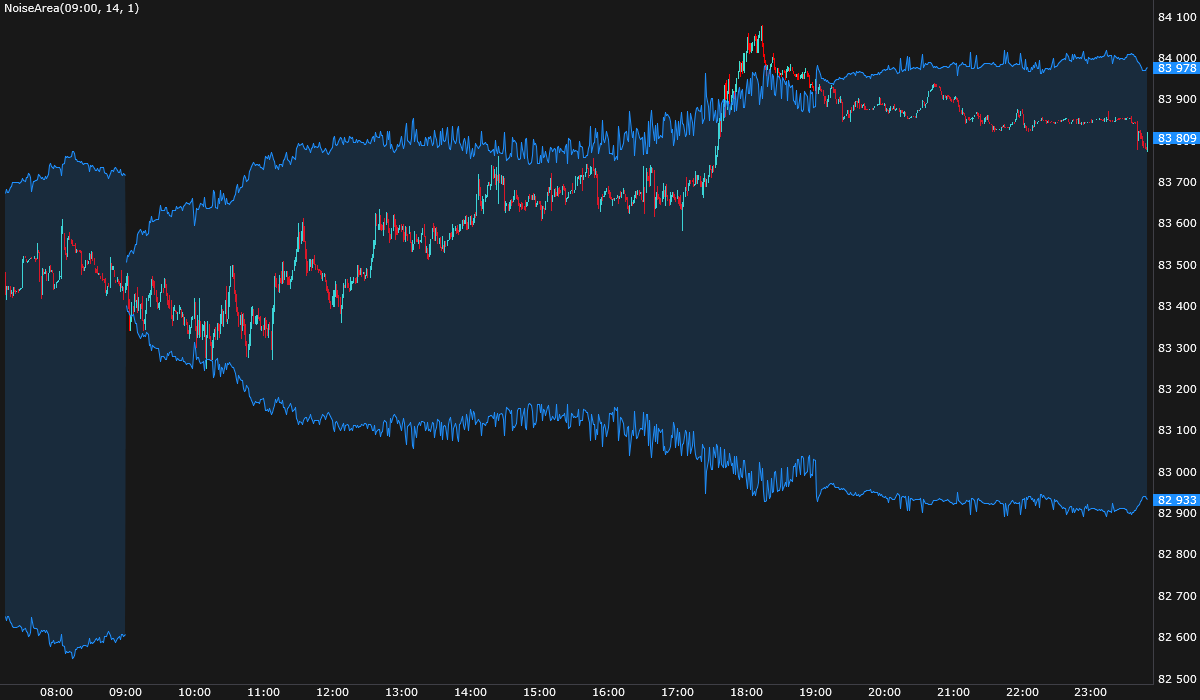
The idea comes from a paper on intraday momentum in a US index fund (Zarattini, Aziz, Barbon): in their work, leaving the area is an entry signal in the direction of the exit, checked at the start and middle of each hour. The area is also useful as a filter: movement inside it is the usual move for this hour, while leaving it says that the day is running wider than usual.
Setup for MOEX: Day start: hour — 10 or 9 (the move is measured from this open), Days — 14, Multiplier — 1, as in the paper. In the first weeks after a schedule change and after holidays, not all past days with the same time are found — the area is less reliable then.
In the JetScalp terminal
SessionLevels, NoiseArea, HighLow; volume-based levels of past days (POC, VAH, VAL) are in the Footprint section.
Summary
- OR, IB, the previous day’s levels and close are reference points shared by everyone; at a level, watch the order book and the tape, and confirm an exit with the bar close.
- MOEX has several opens: the morning session around 07:00, the main session at 09:00, the volume peak at 10:00. For MOEX, set the day start of SessionLevels and NoiseArea explicitly — 7, 9 or 10.
- Most of the volume trades in the main session, and the hour from 10:00 is one of the most active; in the evening volume and volatility are noticeably lower.
- The noise area is the usual move from the open for this hour; it widens toward the evening.
Check yourself
- Why will SessionLevels with the default day start not draw an opening range on
SBER? - You set the day start to 09:00. Which day do the morning-session trades belong to, and how does this affect PDH and PDL?
- The bar volume at 10:05 is twice that at 13:05. Why can you not yet conclude from this that activity is unusual?