Open interest
Open interest (OI) is the number of futures contracts open at the moment: how many positions have not been closed yet. Volume tells you how many contracts changed hands, OI — how many obligations remain in the market after that. This is a practice-level lesson: how a trade changes OI, how to read its change together with price and delta, and where the conclusions end.
How a trade changes OI
Every open contract has a side with a long position and a side with a short one: there are exactly as many long positions in the market as short ones, and that number is the OI. Each trade changes it depending on whether its participants are opening or closing positions:
| Buyer | Seller | OI |
|---|---|---|
| Opens a long | Opens a short | +1 contract |
| Closes a short | Closes a long | −1 contract |
| Opens a long | Closes a long | unchanged: the position passed from one to the other |
| Closes a short | Opens a short | unchanged |
That is why high volume can trade with unchanged OI — the positions simply changed hands — while a small volume can change OI noticeably.
OI and volume
| Volume | Open interest | |
|---|---|---|
| What it counts | How many contracts changed hands | How many contracts are open now |
| How it changes | Only grows during the period | Rises and falls |
| Exists for | Any instrument | Derivatives |
On the Moscow Exchange, OI exists for futures and options; shares and currencies do not have it. On crypto exchanges, open interest exists for perpetual futures (perps) and dated futures, while spot pairs do not have it (lesson Perpetual contracts on crypto exchanges). It reads the same way: rising OI means new positions are being opened, falling OI means positions are being closed, including forcibly, in liquidations.
OI change together with delta
By itself, a change in OI does not tell who was the aggressor. But if you match the sign of the bar’s OI change with the sign of delta (who was the aggressor), you get four pictures:
| OI | Delta | What the data show |
|---|---|---|
| Rising | Positive | Positions were being opened; the aggressors were more often buyers. |
| Rising | Negative | Positions were being opened; the aggressors were more often sellers. |
| Falling | Positive | Positions were being closed; the aggressors were more often buyers — for example, closing shorts. |
| Falling | Negative | Positions were being closed; the aggressors were more often sellers — for example, closing longs. |
Note the wording. The popular “price rises and OI rises, so longs are being opened” is inaccurate: every opened long comes with an opened short. The data let you say who was the aggressor when positions were opened, but not whose position is “right” or who is after what.
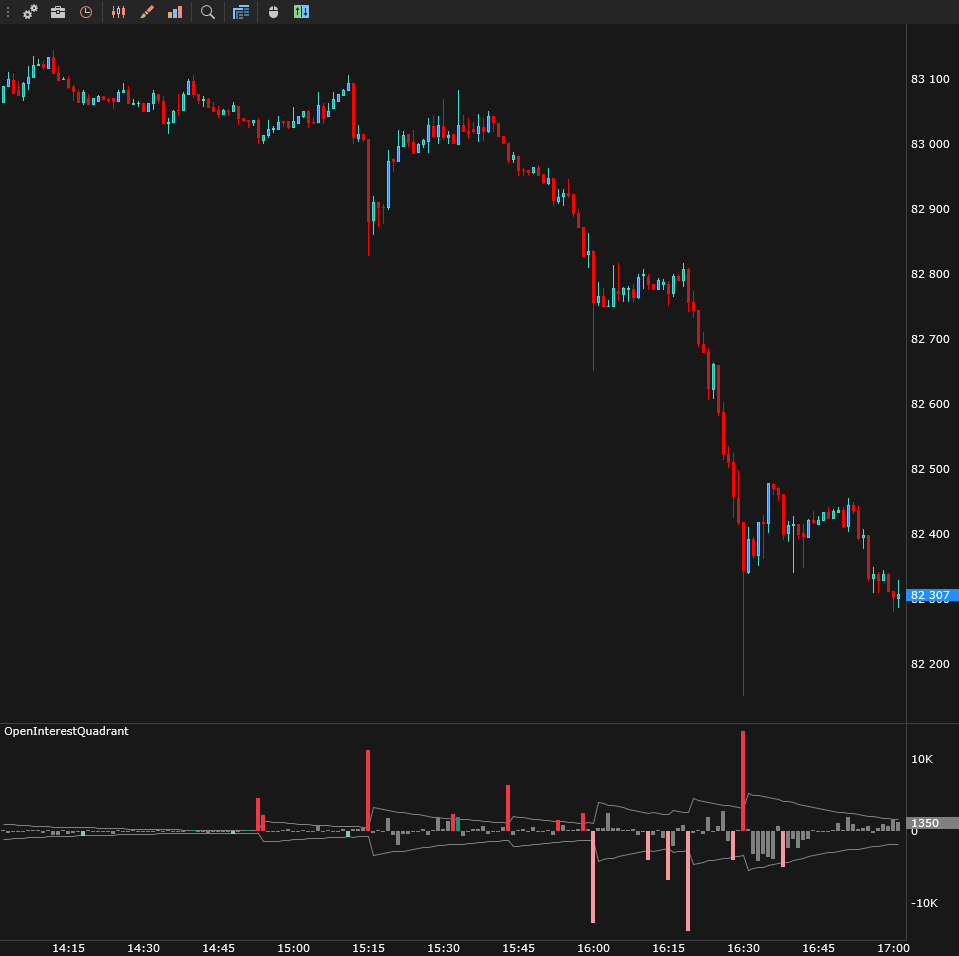
To separate notable OI changes from ordinary noise, they are compared with the typical spread: a change is considered notable if its absolute value exceeds a given number of standard deviations of the OI changes of past bars. Even with the threshold set to one standard deviation, most one-minute bars show no notable OI change, and each of the four pictures above is marked on only a small share of bars. This is how the OI quadrant indicator in the terminal works.
Data limitations
- OI comes with the trades, but not strictly with each one. On the Moscow Exchange the OI value is updated with trades; the OI change at an individual price inside a bar is an approximation: a trade’s OI may not arrive exactly with that trade.
- The boundary between trading days. Between days, OI can change noticeably for reasons other than the trades seen during the day; that is why the OI change of the first bar of the day is compared with caution or left out.
- Contract rollover. Before expiration, positions are rolled from the front contract into the next one: the front contract’s OI falls and the next one’s rises — this is not a “closing” of interest in the market but a transfer.
- Intentions are unknown. A hedger who opened a short and a speculator who opened a short produce the same OI change.
In the JetScalp terminal
OI and its change by bar — the OpenInterest indicator; the OI quadrant — the OpenInterestQuadrant indicator. The indicators work for MOEX futures; for shares, currencies and crypto instruments the pane stays empty. For MOEX futures the OI change is also visible in the footprint: the ΔOI cell mode and the ΔOI row of the statistics below the bars (Footprint).
Summary
- OI is the number of open contracts; there are as many long positions as short ones.
- A trade changes OI by +1 or −1 or leaves it unchanged — depending on whether its participants open or close positions.
- Together with delta, the OI change shows whether positions were opened or closed and who was the aggressor, but not the intentions.
- OI changes at day boundaries and during contract rollover are special cases.
Check yourself
- Why can volume be large while OI does not change?
- Why is the phrase “OI is rising, so longs are being opened” inaccurate?
- What happens to the OI of the front and the next contract before expiration?