Trend and pullbacks
The idea of trend following: if price is already moving one way, trade in the direction of the move and hold the position until the move is canceled. This is a practice-level lesson: two classic forms — the moving average crossover and the pullback entry — how to define the entry, stop loss and exit, and which terminal tools help.
Important: The examples in this lesson review the past and are not trade signals. Every entry needs a stop loss and a position size calculated from risk.
Idea
Why a trend can continue: large participants execute orders in parts over hours, the market absorbs news gradually, and stop losses and forced closes push price further. The trend approach lives on rare big moves: in chop it takes small losses, in a trend it takes a large profit. That is why its win rate is often below half, and the result rests on the ratio of wins to losses.
When it fits
- Price stays on one side of the average and VWAP, highs and lows shift in the direction of the move.
- The day’s VWAP slopes, EfficiencyRatio rises, Choppiness is low (see Market regime filter).
- Volume and delta support the move: volume is higher on impulses with the trend and lower on pullbacks.
In a range the same approach enters and exits again and again with a small loss — that is its main weakness.
Moving average crossover
The simplest form: a fast average (for example, EMA(20)) crosses a slow one (EMA(50)) from below — a reason to look for a buy; from above — a sell. The signal is read on a closed bar.
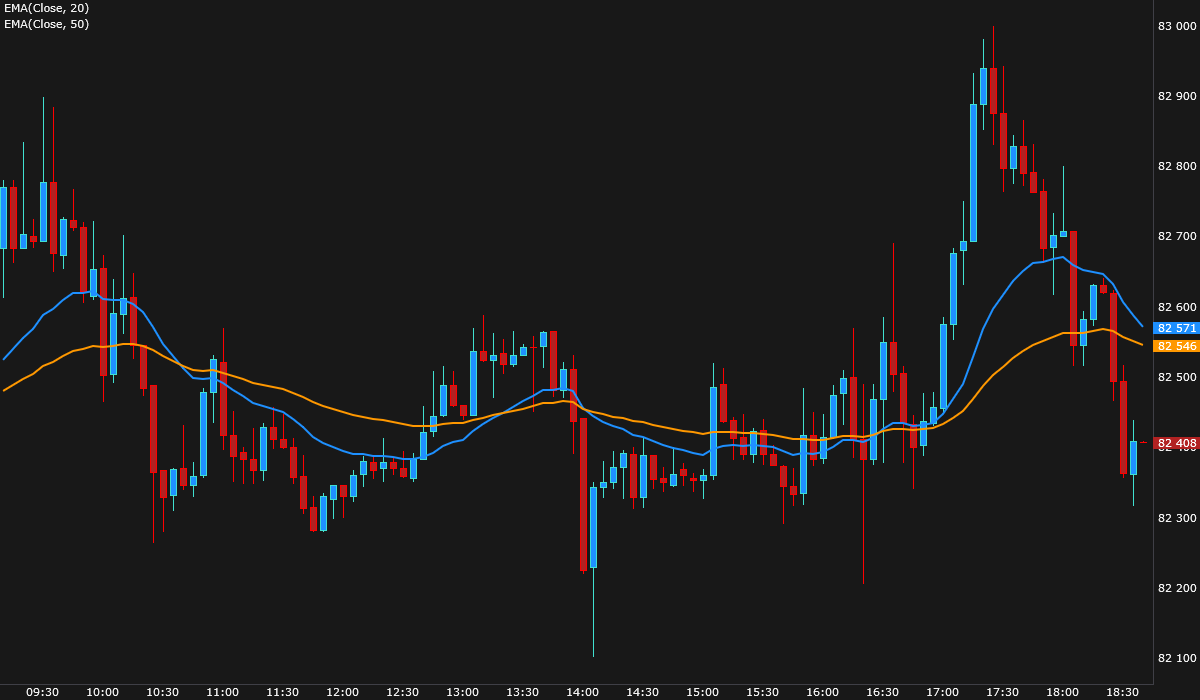
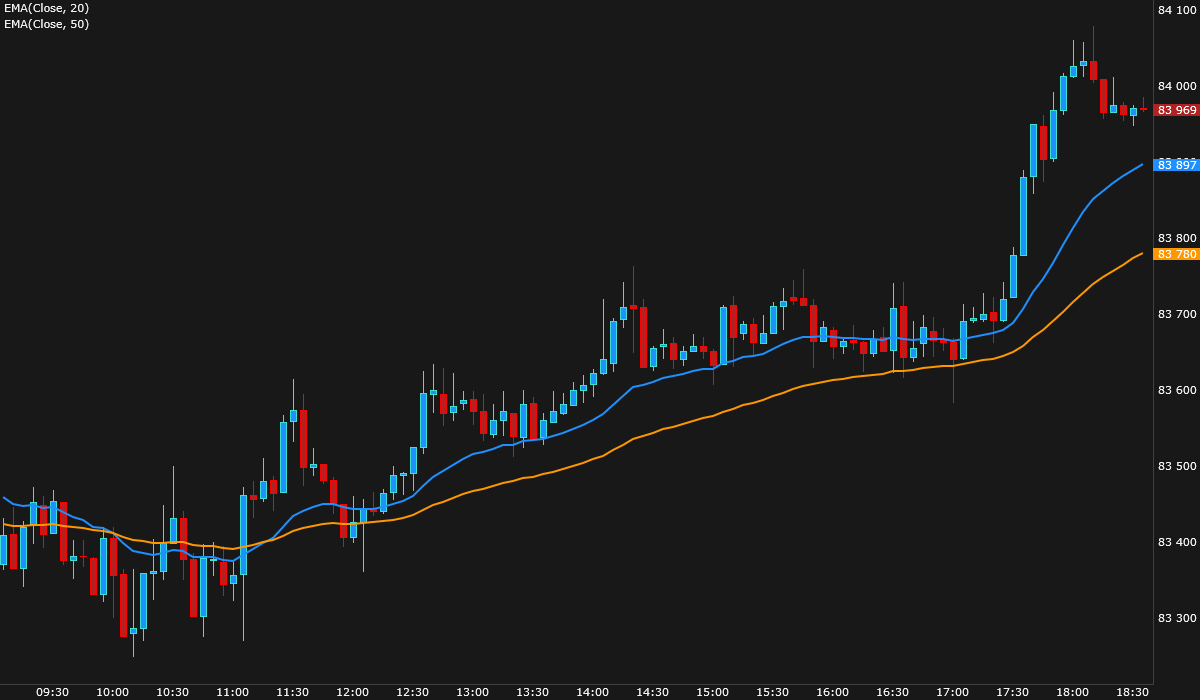
The pair of pictures shows the character of the approach: in chop, a series of small losses; in a trend, one big move. The weak spot of the “exit only on the opposite crossover” rule is visible too: part of the profit is given back while the slow average catches up with price.
Pullback in a trend
A pullback entry is a way to enter with the trend not at the peak but where the stop loss is close.
| Part | How to define it |
|---|---|
| Trend | Price above EMA(50), and EMA(50) rising (mirror it for a sell). |
| Entry zone | A pullback to EMA(20), VWAP, a previous high or the previous day’s POC. |
| Confirmation | A bar touched the zone and closed in the trend’s direction; volume on the pullback is lower than on the impulse, and the footprint shows buying at the zone. |
| Stop loss | Beyond the pullback low with a margin for the spread and noise. |
| Target | The previous extreme, the next profile level or a trailing stop. |
Stop loss and exit
- The stop loss goes where the trend is considered broken: beyond the pullback low, beyond the SuperTrend line, beyond the slow average. A stop that is too close often gets hit by noise — use ATR as a guide.
- Exit — on the opposite signal, by a trailing stop (SuperTrend, ParabolicSAR, the terminal’s trailing stop) or in parts: part of the position at the nearest target, the rest by the trailing stop.
- By time: if the move has not started within the chosen time, the idea was not confirmed.
Common mistakes
- Trading crossovers in a range. Assess the regime first.
- Entering on the impulse itself, far from the average: the stop loss ends up far away and a pullback knocks the position out.
- Moving the stop loss further away when price goes against the position.
- Closing profits on the first pullback and holding losses to the end — the opposite of what the trend approach lives on.
- Changing the average settings after every losing trade.
In the JetScalp terminal
- Averages — MovingAverage, trailing lines — SuperTrend and ParabolicSAR, volatility for the stop — ATR, the day’s fair price — VWAP.
- Trend strength — ADX and EfficiencyRatio.
- Volume on pullbacks and impulses — Footprint and Volume.
- Trailing stop in the order book — Stop loss; an alert when price touches an average — the indicator’s alert lines.
- Theory — the lessons Moving averages and Trend and its strength.
Summary
- The trend approach earns on rare big moves and loses small amounts in chop.
- Before entering, assess the regime: the VWAP slope, price relative to the averages, EfficiencyRatio.
- A pullback gives an entry with a close stop loss; confirmation is a bar closing in the trend’s direction and the behavior of volume at the zone.
- Exiting by a trailing stop or in parts keeps more of the move than exiting only on the opposite signal.
Check yourself
- Why is the win rate of a trend approach usually below half?
- Why is entering on a pullback to EMA(20) more convenient than entering on the impulse?
- What signs on the chart tell you it is chop and crossovers are better skipped?