How price is formed
A price on an exchange appears when one participant’s order meets another’s: one is already resting in the order book, the other arrives and executes against it. This is a basics-level lesson and the key one in the first part: everything said later about the order book, time and sales, the footprint and delta rests on it.
The situation
Time and sales shows a buy of 70 lots at 100.05. The best sell price in the order book was 100.05 before it — and remained 100.05 after it. Buyers bought, yet the price did not rise. Why?
To answer, we need to separate three things that are often mixed up in talk about the market: orders that wait in the order book, orders that execute immediately, and the trades between them.
Limit and market orders
A limit order says “buy 100 lots at no more than 100.03” or “sell 120 lots at no less than 100.07”. If there is no suitable opposite order right now, a limit order does not execute; it rests in the order book and waits. Such orders are called passive: they provide liquidity — an opportunity for others to buy or sell immediately.
A market order says “buy 150 lots right now at the best available prices”. It does not wait; it executes against limit orders already resting in the book. Such orders are aggressive: they take liquidity. A limit order priced so that it immediately finds an opposite order also executes aggressively — what matters to the exchange is not the order type but whether the order arrived at an opposite order that was already resting.
The participant whose order arrived and executed immediately is called the trade initiator, or aggressor. When time and sales shows a “buy”, it means the buyer was the aggressor: they came to a seller’s resting order.
The order book: Bid, Ask and spread
All resting limit orders in an instrument form the limit order book, which the terminal displays as the order book: prices run vertically, with the volume of resting orders at each price.

- Ask (offer) — the best, that is the lowest, price at which someone is willing to sell. You can buy immediately at the Ask.
- Bid — the best, that is the highest, price at which someone is willing to buy. You can sell immediately at the Bid.
- Spread — the difference between Ask and Bid. In the example it is 0.02, or two ticks. There are no orders inside the spread: if someone wanted to buy at 100.04, their order would become the new Bid.
- Mid (midpoint) — the average of Bid and Ask, here 100.04. It is often used as the “current price” when a single number is needed.
How the exchange matches orders
The trading system matches orders by two rules: price first, then time. A seller at 100.05 is filled before a seller at 100.06, and among several sellers at 100.05 the one whose order arrived first is filled first. So every level of the order book is a queue: for example, 100 lots at 100.05 may be three orders of 40, 25 and 35 lots, and a new sell order at 100.05 joins the end of that queue.
A trade is made at the price of the order that was already resting in the book. If a seller is waiting at 100.05 and a buyer sends a limit order “buy up to 100.10”, the trade goes through at 100.05: the buyer gets the best available price.
Execution across several levels
Suppose a market buy order for 150 lots arrives in the order book shown above. There are only 100 lots at the best price of 100.05, so the order takes them and moves on to the next level.
| Trade | Price | Lots | Amount |
|---|---|---|---|
| 1 | 100.05 | 100 | 10,005.00 |
| 2 | 100.06 | 50 | 5,003.00 |
| Total | — | 150 | 15,008.00 |
The average purchase price is the amount of money divided by the number of lots:
Here is the price of the -th trade and is its size in lots. In the example:
The average price is 0.0033 worse than the best price — this is slippage relative to the best price, about a third of a tick. Relative to the mid of 100.04, the purchase cost 0.0133 more per lot: that is what immediate execution cost.

Note two things. One order produced two trades — in time and sales they will appear as two rows with the same time. And the best sell price after the order is already 100.07: the price “rose” because the market buy took all the orders at two levels.
Try it yourself: change the order size and side and watch which levels it takes and how the average price and the spread change.
Levels the order took in full disappear; a level taken in part stays with what is left.
Why buying at the Ask does not necessarily raise the Ask
Back to the situation from the start of the lesson. The buy of 70 lots at 100.05 took 70 of the 100 lots resting at that price. The level was not exhausted, so the best Ask stayed at 100.05. The trade was “at the Ask”, but the Ask itself did not change.
The best sell price changes in only three ways:
- Aggressive buying exhausted the level — as in the 150-lot example.
- Sellers canceled or moved their orders. The Ask can rise without any trades at all: it is enough for everyone resting at 100.05 to cancel their orders.
- New orders appeared inside the spread. A seller who places an order at 100.04 immediately becomes the new Ask and narrows the spread.
Conversely, even a heavy flow of buying may not move the Ask if new sell orders keep appearing in its place. Who exactly was selling — one large participant in pieces, many different participants, or liquidity providers replenishing the level — cannot be established from trades and the order book. But they show what matters most for trading: where liquidity stands, who is more aggressive right now, and whether a level is holding the push — buying goes through while price does not move. This is one of the main ideas of the tutorial, and we will come back to it in the lessons on delta and absorption.
Which price is “real”
At any moment an instrument has several prices: Bid, Ask, mid and the last trade price. The last trade happens sometimes at the Bid (an aggressive seller sold) and sometimes at the Ask (an aggressive buyer bought), so it “jumps” by the size of the spread even if the order book does not change. Chart candles are built from trade prices — which means that small fluctuations on them partly reflect not a change in value but which side the latest aggressor came from.
Liquidity in numbers
For a trader, liquidity is the cost of immediate execution. It has two components:
- half the spread — how much you lose relative to the mid even if your size is smaller than the best level;
- market impact — how much more you lose when your order goes through several levels.
The wider the spread and the thinner the levels, the more expensive it is to enter and exit with market orders. A limit order avoids these losses but pays in another way: it may not be filled, and it is most often filled when the price is moving against you.
In the JetScalp terminal
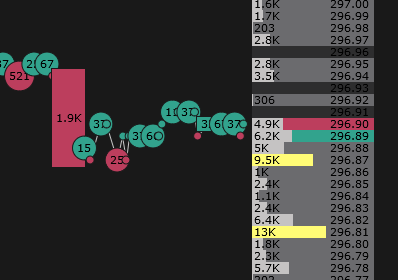
You see the book of orders in the order book window — Order book area, trades in the Tape area, and how to send a market order is described in Market orders.
Common mistakes
- Treating the last trade price as the only price. For calculating entries and exits, Bid and Ask matter more: a market buy will be filled not at the last price but at the Ask and above.
- Confusing orders in the book with trades. 10,000 lots at a level are intentions that can vanish in a fraction of a second; a trade is something that has already happened.
- Sending a market order larger than the best level into a thin order book. The average price will be noticeably worse, and the order itself will move the price against you.
- Explaining every trade by the intentions of a “big player”. Watch what you can see: how price reacts to the flow of trades and to volume in the order book.
Summary
- Limit orders rest in the book and provide liquidity; market orders execute against them and take it.
- Ask is the best sell price, Bid is the best buy price, and the spread is the difference between them.
- Orders are matched by price, then by time; a trade goes through at the price of the resting order.
- An order larger than the best level goes through several prices; the average price is volume-weighted.
- The best price changes when a level is exhausted, orders are canceled or new ones appear inside the spread — not from the mere fact of a trade.
Exercise
In the example above, find the smallest market buy after which the best Ask becomes 100.07. Then switch the example to a sell and find the size at which the average sell price ends up more than one tick (0.01) worse than the best Bid.
Check yourself
- Why might a trade at the Ask not change the Ask?
- How does an aggressive order differ from a passive one, and which of them pays the spread?
- How can the best sell price rise if not a single trade has taken place in the meantime?